

About Longwell Fan Engineering Calculators
Longwell Fan Engineering Calculators is an education product for Web. 37 free fan & HVAC engineering calculators for airflow, static pressure, fan curves and energy — no signup.
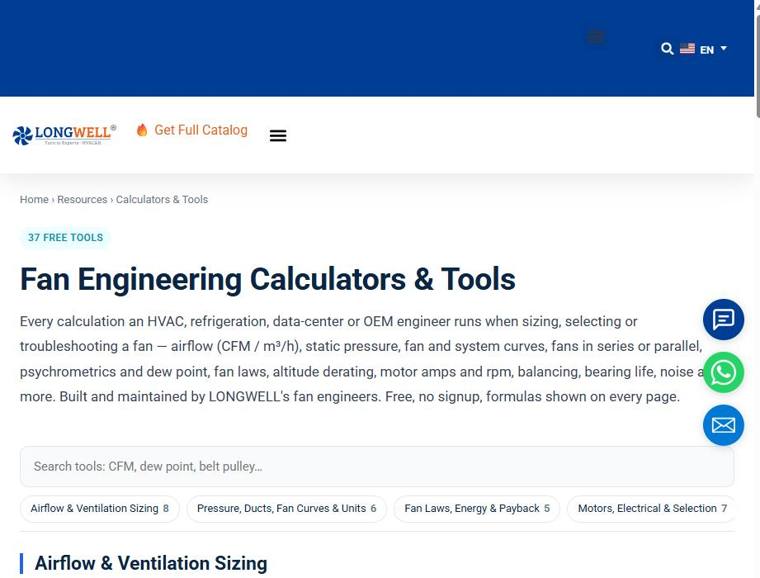
A free, browser-based library of 37 fan and HVAC engineering calculators in eight groups: airflow and ventilation sizing; pressure, ducts, fan curves and units; fan laws, energy and payback; motors, electrical and selection; air properties, testing and commissioning; noise, vibration and reliability; and purchasing and logistics. Tools include CFM / air-changes sizing, duct size and static pressure, fan operating point (catalog curve vs system curve), fans in series and parallel, fan affinity laws, VFD and EC-vs-AC energy savings and ROI, air density at altitude and temperature, psychrometric properties, pitot-tube airflow, balancing grade G6.3 / G2.5 permissible unbalance, belt-drive pulley speed, fan wall and N+1 redundancy, fan noise and blade-pass frequency, MTBF / L10 bearing life, ErP 2026 fan efficiency, and a voltage / frequency / certification checker for 40 export markets. Every tool shows its formula and typical reference values, works in SI and IP units, and lets users share a result by link, copy it as text or cite it in a report. No registration, no paywall, no data upload — calculations run in the browser. Built and maintained by Ningbo Longwell Electric Technology Co., Ltd., a fan manufacturer; the calculators are generic engineering tools with no product pitch.
Most fan sizing mistakes come from three places: guessing the airflow, ignoring static pressure, and forgetting that air gets thinner with altitude and heat. Engineers today piece the answer together from spreadsheets, catalog PDFs and hand calculations. These tools walk the same path an application engineer follows — establish the duty point (airflow + pressure), correct it for the real installation, then check power, noise and life.
HVAC and mechanical engineers, commissioning and balancing technicians, AHU and data-center cooling designers, fan OEM specifiers, and engineering students
At a glance
- Website
- longwellfans.com
- Category
- Education
- Pricing
- Free
- Based in
- Ningbo, China
- Founded in
- 2026
- Platforms
- Web
- Ownership
- Unclaimed ·
- Launched
- 19 Nov 2026
Questions about Longwell Fan Engineering Calculators
Answers from longwellfans.com, Longwell Fan Engineering Calculators's own website.
What is an EC fan and how is it different from an AC fan?
An EC (Electronically Commutated) fan uses a brushless DC motor with onboard electronic commutation, allowing infinite speed control via 0–10 V, PWM, or Modbus signals while reaching 88–93% wire-to-air efficiency. An AC fan uses a fixed-speed or triac-dimmable AC induction motor, typically 55–75% efficient. EC fans cost more upfront but save 30–50% on energy and 70–90% on noise at part-load.
What's the difference between a centrifugal, axial, and cross-flow fan?
Centrifugal fans move air perpendicular to the impeller axis — high static pressure (up to 3.2 kPa), used in AHUs, dust collection, heat exchangers. Axial fans move air parallel to the axis — low static (200–600 Pa), high airflow, ideal for free cooling, condensers, ventilation. Cross-flow fans move air across the impeller — used in fan-coil units and AC indoor units for wide even flow at low pressure.
What is a plug fan?
A plug fan is a centrifugal fan without a scroll housing — the impeller mounts directly into a plenum or AHU section. Typically backward-curved with EC motors (called "Plenum Fans" or "FanGrid arrays"). Allows flexible installation, multi-fan N+1 redundancy, and lower system effect losses. LONGWELL LWBE3G is a plug fan family.
What's the difference between forward curved and backward curved centrifugal fans?
Forward-curved (FC): cheap, compact, high airflow at low pressure, max ~65% η, noisy, used in residential HVAC, small AC units. Backward-curved (BC): expensive, higher static pressure, max 88–93% η, quieter, used in AHUs, FFU, plug fans, professional HVAC. Backward-curved EC plug fans dominate professional HVAC + data center.
What is FanGrid and when do I need it?
FanGrid is an array of multiple smaller EC plug fans (typically 4, 6, 9, or 16) replacing one large belt-drive AC fan in a CRAH or AHU. Benefits: N+1 redundancy without standby unit, lower total noise, easier maintenance (hot-swap), better part-load efficiency. Widely used in data center CRAH retrofit and large AHU programs.
How long do EC fans last in continuous operation?
LONGWELL EC fans are rated L10 = 60,000 hours (~6.8 years 24/7) and L50 = 90,000 hours at 40°C ambient. With 50% load duty at 25°C ambient, real-world MTTF exceeds 120,000 hours (>13 years). Bearings are sealed-for-life; electronic boards conformal-coated.
How do I select the right fan for my AHU?
Five-step selection: (1) Calculate required airflow CFM/m³h from sensible heat load and ΔT. (2) Calculate system static pressure (filter + coil + damper + ductwork losses). (3) Plot operating point on fan PQ curve, prefer BEP at 70–90% max RPM for noise headroom. (4) Verify motor full-load amps fit AHU breaker. (5) Choose IP rating per environment (IP54 indoor, IP55 outdoor, IP67 wet/coastal). LONGWELL Selection…
What is SFP (Specific Fan Power)?
SFP = electrical power input ÷ air volume flow. Unit: W per L/s. SFP captures installed efficiency including motor + drive losses, not just peak fan η. Targets: SFP 1.5 poor (forward AC). EU ErP Lot 6 sets SFP limits for fans >125 W.
Comments 1
From members who've used Longwell Fan Engineering Calculators. Be specific and kind; it helps people decide and helps the makers build.
Reading your listing, this is the line that stayed with me: “Pressure, Ducts, Fan Curves & Units”. It says a lot about the problem you chose for hvac and mechanical engineers, commissioning and balancing t. My one piece of advice: make the first minute prove the value before you ask people for anything. As you get started here, what do you most want the first people using Longwell Fan Engineering Calculators to notice?
Report